























 Canada
 Latin America (English)
 Latin America (Espanol)
 USA
USA
 China
China
 India
India
 Japan
Japan
 Republic of Korea
 South East Asia (English)
 Austria
 Belgium
 France
 Germany
 Italy
Italy
 Netherlands
 Others
 Spain
Spain
 Switzerland
 Turkey
 UK
UK
 Africa (english)
 Africa (français)
 Middle East (english)
 Australia
 New Zealand


Building Resilient Emergency Power Architectures for Continuous Data Center Operation
Emergency power supply systems form the backbone of every modern data center, protecting mission-critical operations from power disruptions that could cost thousands of dollars per minute. A well-designed emergency power architecture integrates UPS systems, battery banks, and backup generators into a seamless protective layer that ensures continuous operation regardless of grid conditions.
Why Emergency Power Architecture Matters for Data Centers
Data centers face unique power challenges. Unlike typical commercial facilities, these environments cannot tolerate even momentary power interruptions without risking data loss, hardware damage, and costly downtime. The emergency power supply serves as the insurance policy that keeps servers running, storage systems accessible, and network connections active when the main utility fails.
Research demonstrates that UPS failures represent the leading cause of data center downtime worldwide. Beyond the immediate operational impact, power outages create cascading problems including incomplete transactions and corrupted databases. Modern data center operators recognize that emergency power represents a strategic investment in business continuity rather than merely backup infrastructure.
Core Components of Emergency Power Systems
A robust emergency power architecture comprises three integrated layers working in coordination:
UPS Systems
UPS systems provide the first line of defense, delivering instantaneous power protection the moment utility voltage drops or fails. These systems maintain stable AC voltage to critical loads without transfer delay, bridging the gap until secondary backup systems engage. Online double conversion UPS systems continuously condition power to remove electrical disturbances while keeping the batteries charged and ready when needed.
Battery Banks
Battery banks store the energy that powers UPS systems during outages. Multiple battery technologies are available for data center applications, including valve-regulated lead acid (VRLA) and lithium-ion batteries, each offering distinct characteristics suited to different operational requirements. Battery capacity determines runtime, providing the critical minutes available for either generator startup or graceful system shutdown.
Generator Systems
Generator systems provide long-term backup power when outages extend beyond battery runtime. Diesel generators can operate indefinitely with proper fuel supply, supporting facilities through extended grid failures and representing the ultimate power resilience for continuous data center operation.
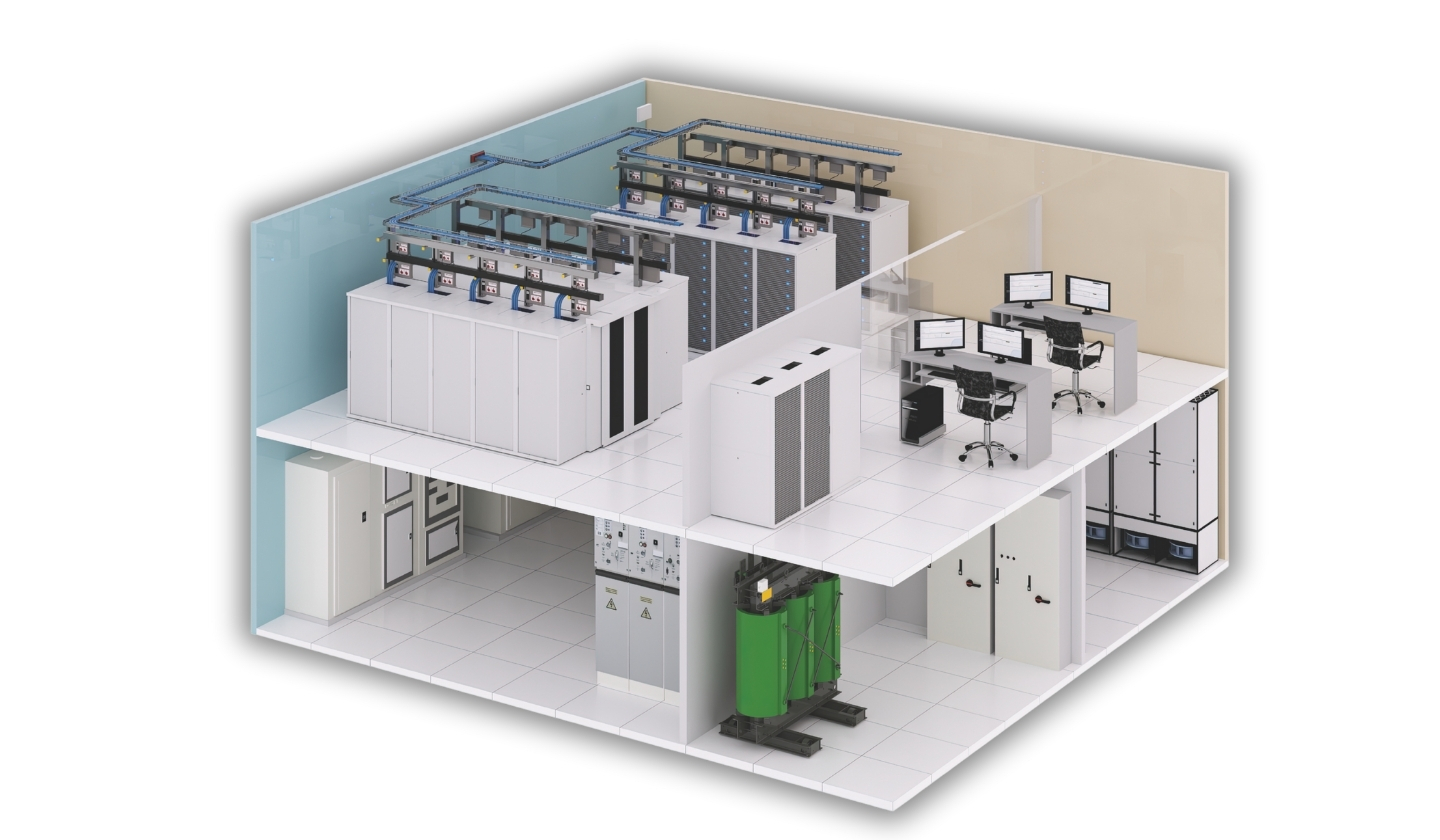
How Legrand UPS Solutions Enable Power Continuity
Legrand offers comprehensive UPS solutions engineered for data center emergency power requirements across multiple product families:
High-Power Modular UPS Systems
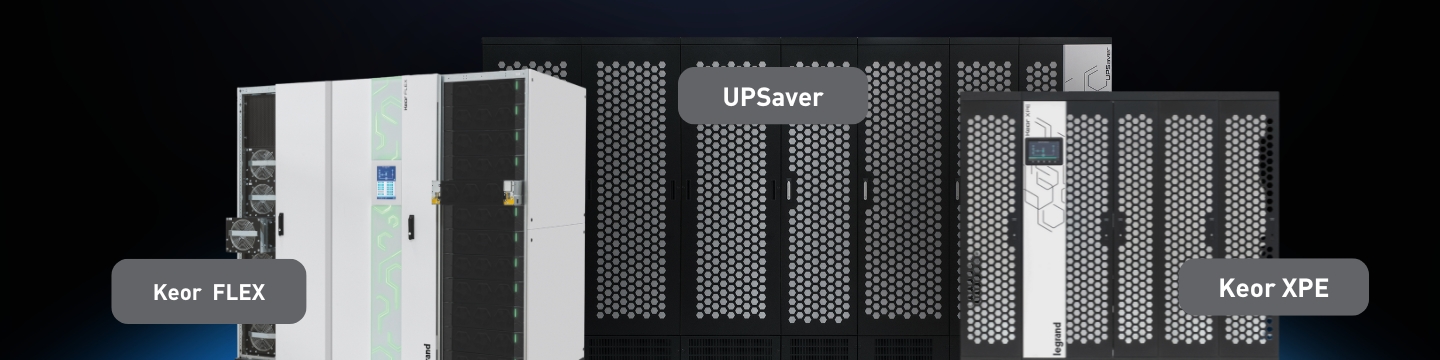
High-Power Modular UPS Systems include Keor FLEX, which delivers industry-leading 98.5% efficiency with scalability from 100kW up to 1.2MW in a single frame and expandable to 4.8MW through parallel configurations. The hot-swappable 100kW modules utilize Silicon Carbide technology for maximum performance with minimal losses. Additional high-power options include Keor XPE (600kVA to 2.1MVA) and UPSaver (333kVA to 21MVA) for large-scale data center deployments.
Modular UPS Platforms
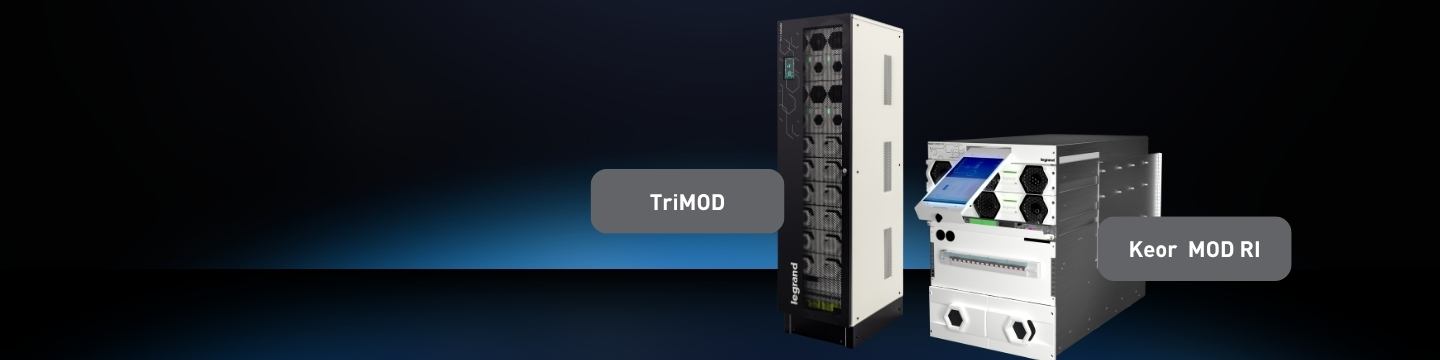
Modular UPS Platforms feature Keor MOD RI for rack-independent applications (25kVA configurations), alongside TriMOD which offers modular architecture from 10kW to 80kW with individual single-phase modules that are redundant and self-configuring.
Conventional UPS Systems
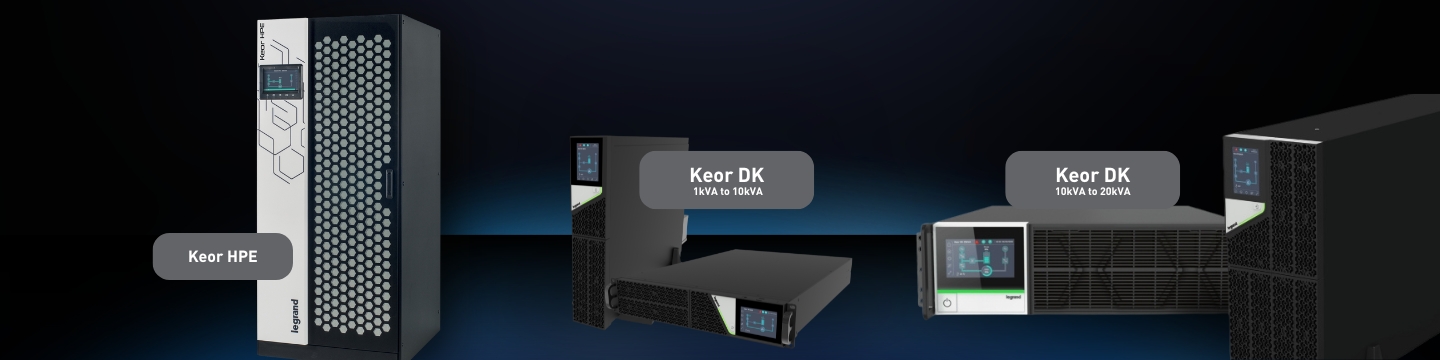
Conventional UPS Systems include Keor HPE, a three-phase UPS family delivering power from 60kW to 600kW with 3-Level IGBT technology, ideal for small-medium data center facilities. Keor DK provides single-phase protection from 1kW to 20kW.
These modular platforms feature hot-swappable power modules in their respective designs, allowing capacity expansion and module replacement without system downtime within each product family's specific architecture.
Battery Technology and Flexible Energy Storage Options
Legrand UPS systems support multiple battery technologies to meet diverse operational requirements. VRLA batteries remain widely deployed in sealed, maintenance-free configurations, offering reliable performance and proven track record in data center applications. Lithium-ion batteries provide extended design life, typically 8–12 years compared to 3–5 years for VRLA, along with reduced footprint requirements and faster recharge times.
Battery cabinet solutions are designed to accommodate various battery technologies and capacities across different UPS families. Universal battery cabinets support three-phase Legrand UPS systems from 10kVA up to 800kVA, with configurations varying by UPS model and application requirements.
Advanced systems like Keor FLEX are engineered to integrate with lithium-ion technology, providing options that reduce footprint, improve energy efficiency, and extend service intervals for facilities prioritizing these characteristics.
Seamless Generator Integration for Extended Runtime
Emergency power architecture achieves its full potential through proper generator integration. UPS systems bridge the 10–15 second gap typically required for automatic generator startup. Once the generator reaches stable operating voltage, the UPS seamlessly transfers load to generator power while remaining online to condition the output.
The UPS continues filtering generator power quality variations, protecting sensitive electronics from voltage fluctuations. UPS systems include generator compatibility features ensuring reliable operation, with input voltage tolerance and power factor correction capabilities that vary by model and family.
Power Distribution and Cable Management
Effective emergency power architecture extends beyond generation and storage to encompass intelligent power distribution. Power distribution units connected downstream from UPS systems provide granular control over individual equipment circuits. Legrand's PDU solutions complement UPS systems by offering network-monitored outlets and remote control capabilities.
Cable management infrastructure plays a critical role in system reliability. Proper cable routing prevents accidental disconnections and facilitates rapid troubleshooting. Well-organized cabling between UPS systems, battery cabinets, and distribution panels ensures maintenance technicians can quickly resolve issues.
Cost Optimization and Operational Efficiency
Strategic emergency power design balances resilience against capital and operating costs. Modular UPS architectures allow incremental capacity additions that match actual demand growth. Redundant configurations enable systems to operate efficiently while maintaining backup capacity during normal operation.
Regular maintenance scheduling extends equipment lifespan and helps prevent emergency failures. Monitoring tools can identify developing issues, allowing planned maintenance during scheduled windows rather than emergency repairs during outages.
Partner with Legrand for Complete Emergency Power Solutions
Legrand delivers integrated emergency power architectures engineered for maximum uptime in data center environments. Our comprehensive portfolio includes high-power modular UPS systems, modular platforms, conventional UPS systems, battery cabinet solutions supporting multiple battery technologies including VRLA and lithium-ion, power distribution units, and intelligent monitoring solutions that work together seamlessly.
Contact Legrand's data center power specialists to design an emergency power system tailored to your facility's specific requirements and budget, ensuring your critical operations never skip a beat.
Related Downloads