























Logo print

Simplifying Mac Mini Deployments with KVM-over-IP

Blog 27/02/2026
LegrandRaritanData Center White SpaceKVM & Serial

Apple Mac Mini devices have become a popular choice for infrastructure managers to test Apple-specific applications on desktop and mobile devices. While Apple's introduction of its own silicon in 2020 has improved performance and enabled more robust virtualization, the closed nature of the Apple ecosystem has posed challenges. As a result, development teams need to use dedicated hardware and software that go well beyond standard development and testing tools.

One of the biggest pain points is deploying applications at scale. Without a consistent, repeatable deployment model, every new device added requires manual setup and configuration. When combined with the need to add each individual device to a mobile device management (MDM) system, it quickly becomes a manual, time-intensive exercise. These challenges don’t stop after deployment either; ongoing updates or maintenance become difficult to implement, particularly when physical access is limited, placing a heavy burden on infrastructure teams.

Collectively, these hurdles slow down development timelines and make it difficult for infrastructure managers to efficiently deploy and manage Mac devices.


Enabling Automation and Remote Control with KVM

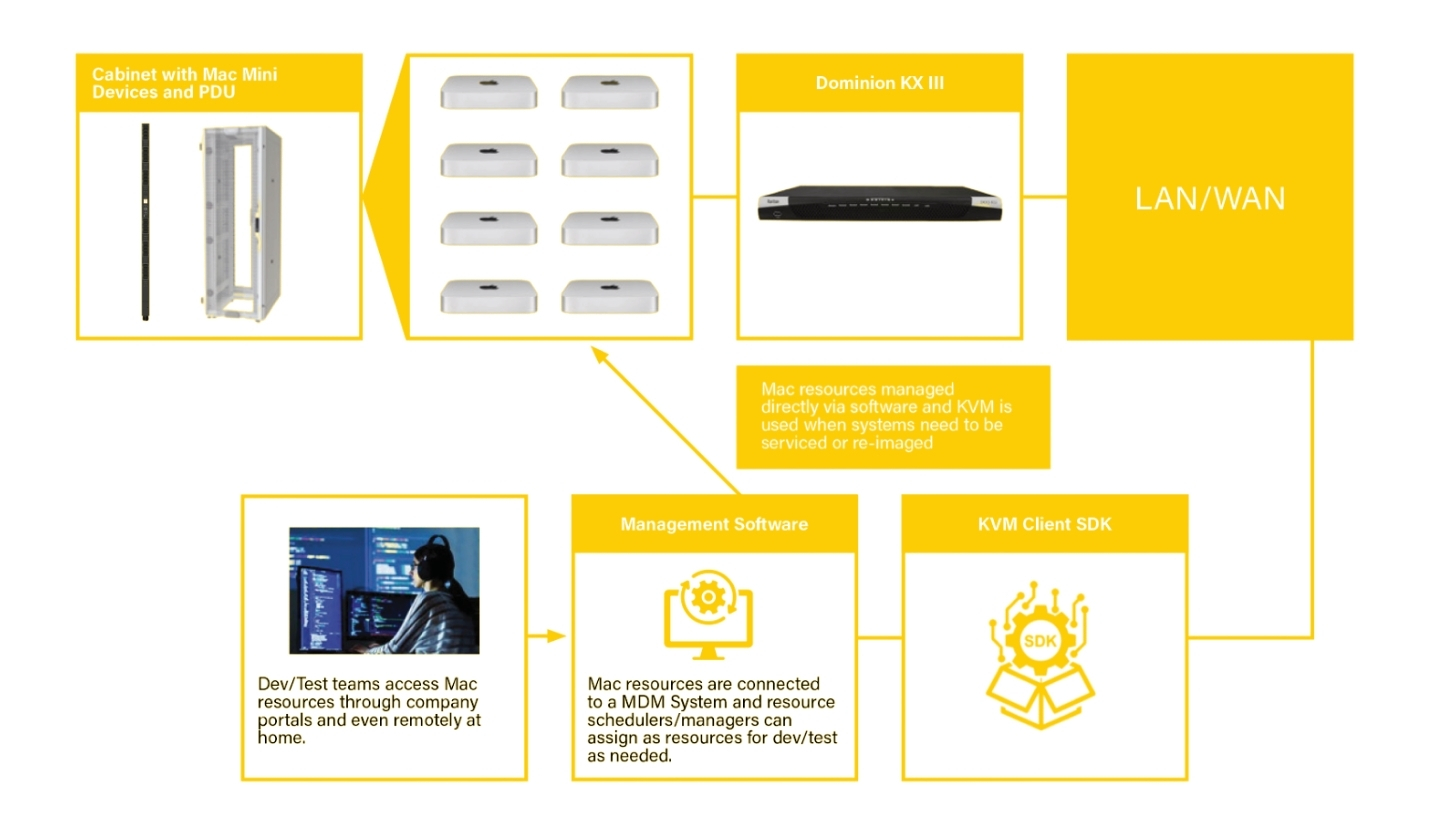
To address these challenges, Raritan’s KVM technology offers a practical way to simplify and streamline Mac infrastructure setup and maintenance. Using the Dominion® KX III, IT teams can remotely access and control large fleets of Mac Mini devices at both the hardware and software levels, reducing deployment time from hours to minutes.
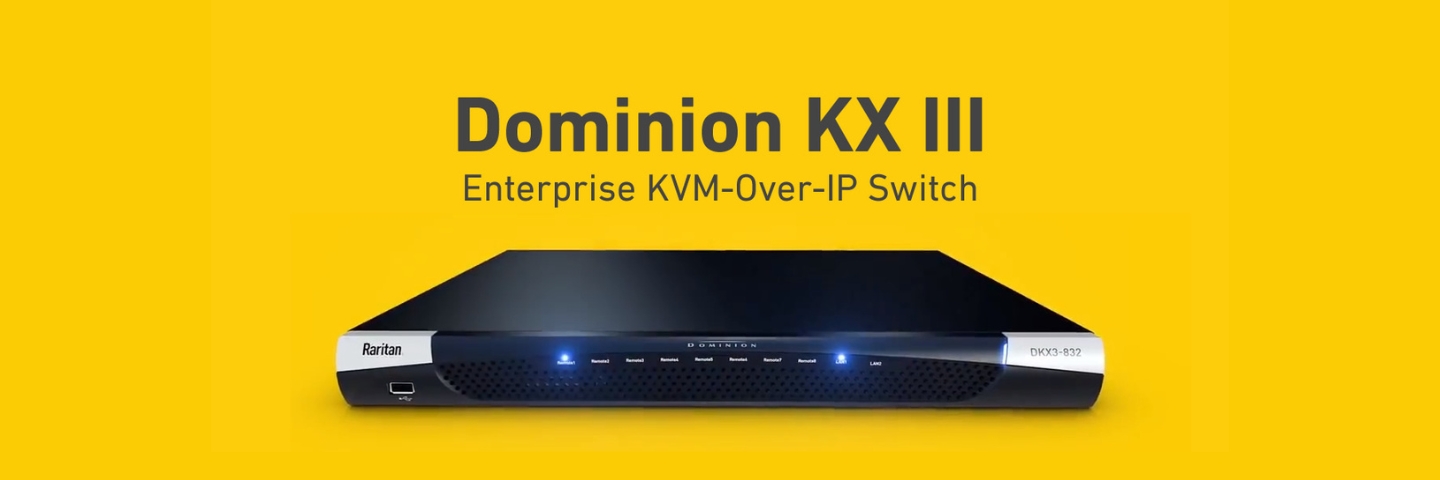
Raritan KVM Dominion® KX III

When combined with Raritan’s Software Development Kits (SDKs), infrastructure managers can script and standardise processes such as initial macOS setup, configuration changes, and testing workflows. Instead of manually stepping through setup screens on each individual device, actions performed on one system can be programmatically replicated across hundreds—or even thousands—of Macs simultaneously.

This approach transforms Mac deployment into a scalable, repeatable process, significantly reducing the time required to set up, deploy, and test each Mac Mini device.


Faster Deployment, Lower Operational Overhead

By removing the need for hands-on configuration, teams can dramatically accelerate Mac infrastructure rollouts while simplifying long-term management. Automated setup, remote monitoring, and centralised control allow IT teams to spend less time on routine tasks and focus on higher-value initiatives, improving overall efficiency and productivity.


A Smarter Way to Manage Mac Infrastructure

Raritan’s KVM products, paired with open-source SDKs, provide a streamlined, centralised solution for managing the large-scale deployment and testing of macOS systems. The result is faster deployment, improved efficiency, and greater control, helping infrastructure teams keep pace with the growing demands of Apple application development without increasing operational complexity.

For more information on the Dominion® KX III, visit this website

A Smarter Way to Manage Mac Infrastructure


Rear Door Heat Exchangers (RDHx): Myths, Benefits & Data Center Cooling

Blog 27/02/2026
LegrandUsystemsData Center White SpaceCooling

Rear Door Heat Exchangers (RDHx): Myths, Benefits & Data Center Cooling

Data center cooling is undergoing a fundamental shift. Increasing rack power densities, AI-driven compute loads, and the constant pressure to improve energy efficiency are exposing the limitations of traditional room-level cooling strategies. As operators push more compute capacity into existing footprints, thermal management is no longer just an engineering challenge; it is now a business-critical priority.

Among the technologies increasingly entering the conversation are rear door heat exchangers (RDHx). Yet despite their growing adoption across high-density environments, RDHx systems are still frequently misunderstood.

To better understand the role of RDHx in modern data centers, it’s worth exploring how the technology works, where it adds value, and why several long-standing myths no longer hold up.


Why Cooling Strategy Is Being Rewritten

For years, conventional data center cooling relied heavily on perimeter CRAC/CRAH units, raised floors, and carefully managed airflow. This model worked well when rack densities were modest, and heat loads were relatively predictable, but that landscape has changed.


Today’s facilities must accommodate:

  • High-density compute clusters
  • GPU-heavy AI workloads
  • HPC environments
  • Edge deployments with constrained space
  • Aggressive sustainability targets


These shifts are driving a move away from purely room-based cooling toward more targeted heat-removal approaches.

This is precisely where rear door heat exchangers offer compelling advantages.


What Is a Rear Door Heat Exchanger?

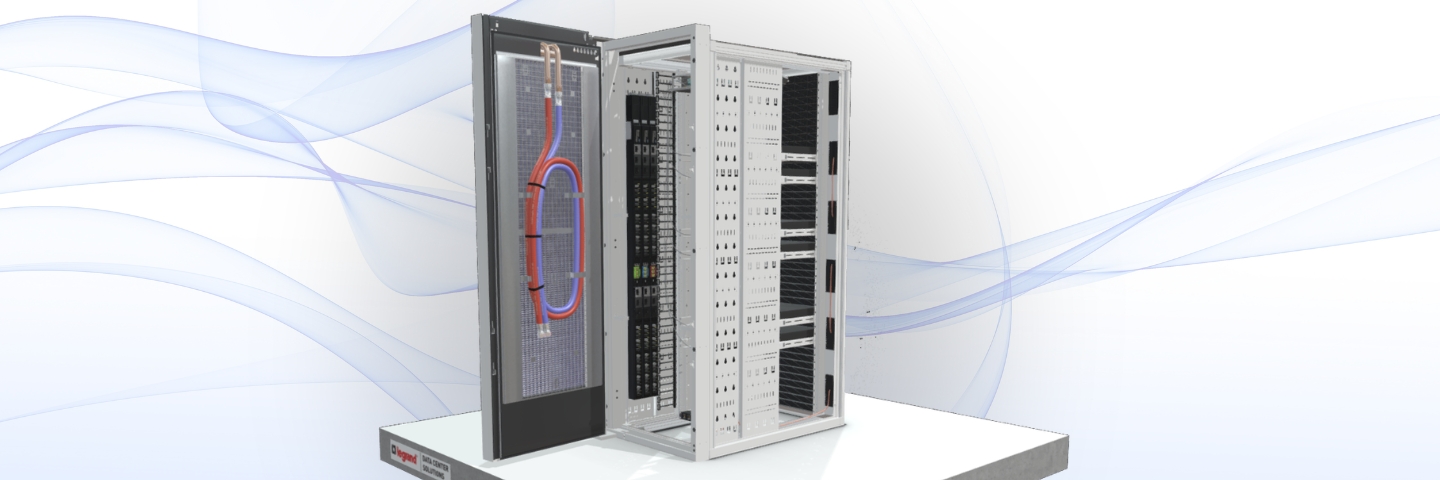
A rear door heat exchanger is a liquid-based, air-assisted cooling system mounted directly on the rear of a server cabinet. Rather than attempting to cool an entire room, RDHx focuses on removing heat where it is produced — at the rack level.

What Is a Rear Door Heat Exchanger?

The operating principle is simple:

  • IT equipment fans draw in ambient air
  • Hot exhaust air is expelled from the equipment
  • That hot air passes across a liquid-cooled heat exchanger
  • Exhaust heat transfers into the liquid-cooling fluid within the heat exchanger
  • Cooled air is expelled into the data hall at, or just below, the predetermined temperature

The result is immediate and localized heat removal without disrupting established airflow architectures.

By extracting heat at the source, RDHx significantly reduces the burden on room-level systems.


Myth 1: “Rear Door Heat Exchangers Are Too Expensive

Cost concerns are the most common barrier — and the most frequently misinterpreted.

RDHx may entail a slightly higher initial capital cost than traditional air-only solutions. However, evaluating cooling technologies purely on purchase price ignores the metric that truly drives long-term value: total cost of ownership (TCO).


Rear door heat exchangers influence operational economics in several important ways:

  • Reduced energy consumption: Targeting heat at its source lowers the amount of air that must be moved and cooled, reducing the energy needed for cooling infrastructure.
  • Less overcooling: Precision heat removal reduces the need to cool the entire room.
  • Lower strain on mechanical infrastructure: By handling heat before it reaches room-level systems, RDHx solutions ease the load on CRAC/CRAH units and chillers, enabling them to operate more efficiently.
  • Improved scalability without expansion: Rack-level heat management allows facilities to support higher densities, avoiding white-space expansions.


In high-density deployments, these cumulative savings often offset initial investment far faster than many expect.

Viewed through an efficiency and lifecycle lens, RDHx is frequently a cost-reduction strategy rather than an expense increase.


Myth 2: “RDHx Systems Are Complicated and Difficult to Maintain

Another persistent misconception is that RDHx technology automatically implies operational complexity.


Modern RDHx systems are specifically designed to avoid this problem. Unlike traditional cooling architectures involving extensive ducting, raised floor management, and multiple interacting subsystems, RDHx solutions are mechanically straightforward:

  • They integrate directly onto standard rack footprints
  • They feature intuitive monitoring and control interfaces to simplify use
  • They reduce reliance in specialized support
  • They typically require low maintenance


In practice, many facilities discover that RDHx simplifies cooling management rather than complicating it.


Myth 3: “Rear Door Heat Exchangers Aren’t Suitable for Existing Facilities

Perhaps the most misleading myth is the belief that RDHx requires disruptive redesign or is viable only for greenfield builds.

In reality, RDHx is particularly attractive in retrofit and hybrid environments.


Best-in-class systems are engineered for compatibility with:

  • A wide range of server racks
  • Existing cooling systems
  • Legacy and high-density infrastructure


This flexibility allows operators to incrementally introduce RDHx exactly where densities demand it, without large-scale mechanical modifications.

For facilities seeking to extend infrastructure life or accommodate new workloads without expansion, RDHx often becomes a practical modernization tool.


RDHx and the Density Challenge

RDHx and the Density Challenge

High-density compute is reshaping thermal priorities. AI clusters, GPU farms, and HPC deployments generate highly concentrated heat loads that challenge even well-designed airflow systems. Attempting to manage these loads solely through room-level cooling often results in inefficiencies, hotspots, and increased energy use.


RDHx address this challenge directly by:

  • Removing heat before it enters the room
  • Stabilizing rack exhaust temperatures
  • Enabling greater cabinet densities
  • Reducing recirculation risks


This rack-centric approach aligns naturally with the direction of modern compute design.


A Real-World Illustration: ColdLogik RDHx

A Real-World Illustration: ColdLogik RDHx

The practical value of RDHx becomes particularly clear when examined through real deployments.

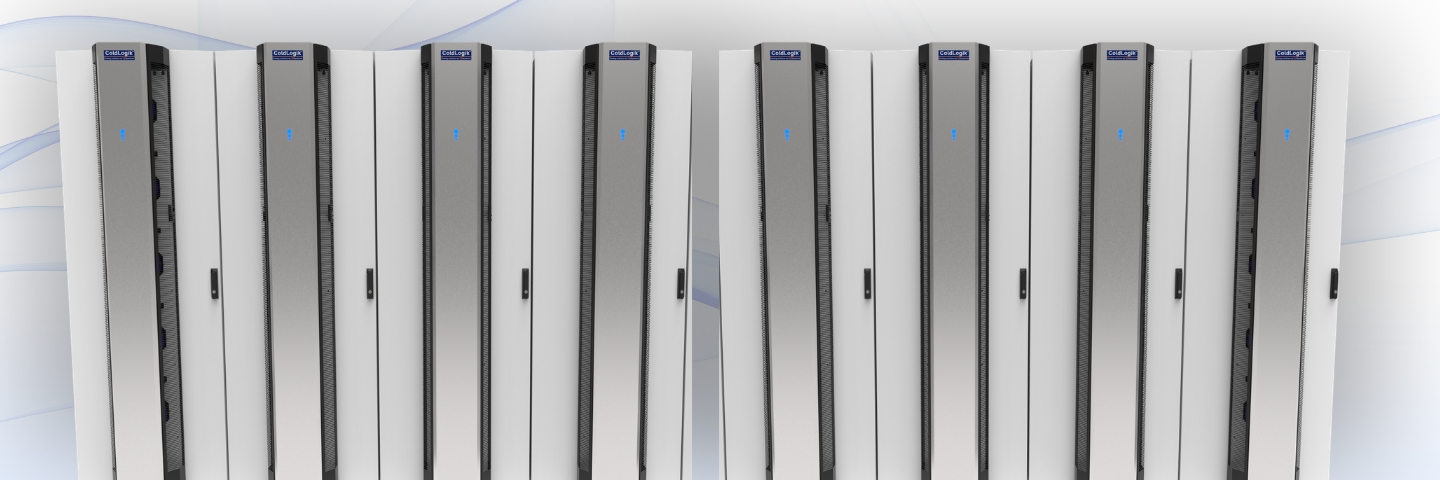
ColdLogik RDHx, developed by USystems (a brand of Legrand), demonstrates how RDHx technology performs under demanding conditions.


At the University of Cambridge’s West Cambridge Data Centre, ColdLogik RDHx was deployed as part of a hybrid cooling strategy supporting high-performance computing growth. The results were significant:

  • Cabinet power densities increased from approximately 30 kW to 44 kW per rack
  • Data hall capacity expanded from 900 kW to 1.2 MW
  • Thermal stability and cooling efficiency were maintained


Equally important, the system’s design supported broader efficiency objectives. ColdLogik RDHx integrates with chilled water, glycol, and air-cooled systems, enabling configurations such as:

  • 100% free-cooling operation with hybrid dry coolers
  • Closed-loop heat removal without operational water consumption
  • Reduced reliance on room-level cooling systems


By removing substantial heat loads at the rack level, the technology enables density growth without disruptive infrastructure changes.


Rethinking Cooling Assumptions

RDHx are not niche solutions or experimental technologies. They represent a field-proven method of addressing challenges that are now central to data center design:

  • Density growth
  • Energy efficiency
  • Sustainability targets
  • Infrastructure longevity


As compute architectures continue to evolve, cooling strategies must evolve with them.

The key is moving beyond outdated assumptions and evaluating RDHx based on measurable operational impact rather than perception.


Final Thoughts

Cooling decisions increasingly influence both performance and economics. Rear door heat exchangers provide operators with a powerful solution for managing density, improving efficiency, and extending facility capabilities - often without the disruption traditionally associated with infrastructure upgrades.

For organizations navigating AI expansion, HPC growth, or modernization initiatives, RDHx deserves serious consideration. To find out more about the benefits of rear door cooling, visit our website here.

Intelligent Rack PDUs for AI Data Centers | High-Density Power & Monitoring

Blog 27/02/2026
LegrandRaritanServertechData Center White SpacePDUs

Intelligent Rack PDUs for AI Data Centers | High-Density Power & Monitoring

AI server racks demand a significant amount of power, necessitating a stable and reliable power supply 24/7. Any fluctuations or disturbances in the power feed to these high-value assets can have a serious effect on their ability to support advanced computing workloads. Therefore, ensuring that your intelligent rack PDU (Power Distribution Unit) meets these demands is a critical consideration for data center operators.


Where once a rack PDU was considered a basic power strip to power 10-20 kW per rack, in the era of AI, high-capacity intelligent PDUs are essential for managing and monitoring rack densities that increasingly exceed 70-100 kW per rack. High-density data centers, hyperscalers, and colocation facilities not only require PDUs with high-density designs, but also advanced power management, metering, and monitoring capabilities. These features help prevent circuit overloads, safeguard equipment, and optimize energy efficiency.


So, what functionalities should operators consider when selecting a high-density rack PDU for their AI and HPC infrastructure?


High-Density Power and Outlets

High-Density Power and Outlets

In response to growing power demands, operators should choose high-density PDUs capable of supporting higher power loads. Additionally, the form factor is critical to ensure these PDUs fit seamlessly into densely packed rack environments while accommodating increasing power requirements.

For example, Legrand’s Raritan PX4 Rack PDUs and Server Technology PRO4X PDUs feature HDOT Cx (High Density Outlet Technology) hybrid IEC C13 and C19 outlets. This design allows C14 and C20 power cables to be installed in a single flexible outlet, maximizing the number of outlets in a single PDU and the physical rack space available to support compute-intensive applications.


These advanced rack PDU solutions are designed to meet even the most demanding power needs with customizable options including form factor, breaker count, outlet type, and more:

  • Voltages from 208V to 480V AC
  • Input current from 16A to 125A
  • Power Capacity of 10 kW to 90 kW+
  • Form factor options from vertical 0U and horizontal 1U to 3U
  • Up to 24 20A 10kAIC hydraulic-magnetic circuit breakers


Universal Input for Dynamic Power Configurations

Universal Input for Dynamic Power Configurations

Given the fluctuating power demands of AI workloads, data centers often face changes in their input power infrastructure or power density. Traditionally, PDUs were purchased based on an existing set of requirements, meaning they had to be swapped out as those requirements changed. However, the PX4 and PRO4X PDUs feature a Universal Input option that supports both single-phase and three-phase Legrand Universal Input cord configurations. This one-size-fits-all feature supports future requirements changes without the need for swap-outs. This flexibility saves time and money for data centers.


Advanced Power Quality Monitoring & Management

AI servers can contribute to power quality issues, such as harmonic distortions, or current variations, leading to unplanned downtime or stranded capacity. To prevent downtime before it escalates, the PX4 and PRO4X Rack PDUs offer a comprehensive set of intelligent features, including real-time visibility, reporting, and alerting of power metrics and events. Key features include:

  • Integrated ±0.5% energy metering accuracy
  • Advanced power quality monitoring, covering neutral voltage, total harmonic distortion, and voltage dip and swell metrics at both the PDU's inlet and outlets
  • Circuit breaker trip forensics with waveform capture
  • Plug-and-play rack management accessories


By analyzing the collected data, technicians can identify power quality issues at the rack level and determine their causes. This insight enables data center operators to create effective power quality mitigation plans that align optimization strategies with sustainability goals.


Environmental and Security Monitoring

With increasing AI workloads, data centers experience higher power consumption and heat generation, which can impact cooling efficiency and operational costs. To optimize cooling and prevent energy waste, it’s essential that rack PDUs can monitor environmental factors like temperature, humidity, and airflow.


The PX4 and PRO4X PDUs offer a wide range of rack-based, plug-and-play solutions for managing critical IT devices effectively. These include:

  • Environmental and security sensors
  • Electronic smart door locks
  • Asset management tags and sensors


By using sensors to monitor these conditions, data centers can protect equipment from damage and enhance security by detecting misuse or suspicious activities.


Cybersecurity

Cybersecurity

Today’s rack PDUs are designed as intelligent, networked devices. However, this connectivity also introduces new cybersecurity risks, and many legacy PDUs still lack essential protections and remain at risk.

Legrand has integrated advanced cybersecurity features into its PX4 and PRO4X intelligent rack PDUs, powered by the Xerus™ firmware platform, including:

  • Secure Boot: This feature ensures that only verified firmware runs on your PDU, preventing tampering and malicious code execution.
  • Vulnerability Testing (VAPT): Each firmware version undergoes thorough internal and third-party testing, including penetration testing with industry-standard tools such as Nessus.
  • Encrypted Communications: All devices utilize AES 128b/256b encryption, along with firewall support and robust password policies.
  • SB 327 & NISTIR 8259 Compliance: The PDUs meet or exceed the requirements of leading security regulations for IoT devices.
  • Stringent Internal Standards: All connected products adhere to the Legrand security policies for IoT devices.
  • Frequent Firmware Updates: There are two major and six minor updates each year, with urgent patches delivered promptly.
  • Customizable Alerts: Intelligent features such as SmartLock™ and webcam triggers provide real-time visual alerts and automated response protocols for unauthorized access events.


Legrand: Meeting Your AI Demands

As AI adoption continues to grow, Legrand’s industry-leading, high-density PDUs will help data centers manage the transition to significantly higher capacities, providing the flexibility and intelligence required to support evolving power infrastructures.

To learn more about our intelligent rack PDUs and their capabilities, visit our website here.


Access Our White Paper on Solving Power Quality Pain Points

Download our White Paper: Solving Power Quality Pain Points to gain a deeper understanding of why measuring total harmonic distortion (THD) is essential to modern data centers and how having circuit breaker trip forensics available at the rack PDU makes sense to address several data center power pain points.


The Infrastructure Behind Valentine’s Day Connections

Blog 12/02/2026
LegrandData Center White SpacePDUsCoolingUPSPower Distribution

The Infrastructure Behind Valentine’s Day Connections

At first glance, the connection between a data center and Valentine’s Day may seem unrelated, with the link appearing slightly tenuous. But look a little closer, and it becomes clear that Valentine’s Day is, like data centers, at its heart about one thing: strong, dependable connections.

Without a reliable data center infrastructure, staying in touch with our loved ones would be far from seamless. Missed WhatsApp messages, delayed video calls, and interruptions when uploading those all-important Valentine’s Day photos would become the norm.

According to the National Retail Federation and Prosper Insights & Analytics, consumer spending on Valentine’s Day in the US alone is expected to reach a record of $29.1 billion. As consumers increasingly turn to digital channels for gifts, experiences, and getaways, the digital infrastructure behind the scenes faces intense pressure to deliver the uptime, speed, and reliability required to meet demand.

Valentine’s Day is about connections, but in a world powered by data and always-on technology, connection isn’t just meaningful - it must always be dependable.

At Legrand, we know that every online connection depends on a data center, a digital network, or a critical system that operates continuously. Beyond Valentine’s Day, the reality is simple: every connection needs unfailing power, reliable cooling, and trusted scalable infrastructure.


Power You Can Count On Power You Can Count On 

Every spike in digital activity - from online orders and payment processing to video calls and content uploads - depends on uninterrupted power. In the lead-up to days like Valentine’s Day, when digital platforms experience sharp increases in traffic, power infrastructure must be constantly available and ready to respond instantly and reliably.

Legrand’s portfolio of UPS systems, overhead track busway, and intelligent power distribution units (PDUs) is designed to support the most demanding mission-critical, high-density environments, maintaining resilience and service continuity under changing and increasing loads.

Solutions such as the Keor FLEX high-power modular UPS provide redundancy, scalability, and rapid response to power events, ensuring uptime when demand is highest and tolerance for disruption is lowest. Its hot-swappable architecture enables quick maintenance with zero downtime, supporting continuous operation in mission-critical environments.

The Starline Track busway delivers scalability and flexibility, allowing operators to deploy or relocate power anywhere they need it at any time, without shutting down live systems. Plug-in power units can be installed within minutes, adapting quickly to changing IT loads. Combined with the best-in-class intelligence and unsurpassed density and flexibility of the Raritan PX4 and Server Technology PRO4X rack PDUs, operators can maintain visibility, control, and maximum uptime across the data center.

Reliable power is the foundation that keeps digital services available, not just during peak moments, but continuously.


Cooling That Protects Performance Cooling That Protects Performance 

As workloads increase, so does heat density. High-performance computing, AI-driven services, and always-on digital services place sustained pressure on data center thermal environments, particularly during peak usage periods.

Legrand’s cooling solutions, including the ColdLogik Rear-Door Heat Exchanger, manage heat efficiently at the source. By removing heat directly from the rack, these systems protect equipment, maintain performance, and reduce the risk of downtime during peak demand.

Effective cooling is not optional - it is essential to sustain service continuity.


Scalable Infrastructure for Growing Demand Scalable Infrastructure for Growing Demand 

Valentine's Day is just one example of how digital demand can surge during seasonal periods. While data centers can plan for these more predictable spikes, infrastructure must also scale quickly and efficiently to support unexpected increases in load.

Legrand’s modular power solutions, cabinets and containment, and structured cabling are designed for flexibility, enabling operators to expand capacity with less complexity and disruption. This approach supports better energy management and smoother scaling.


Reliability, Connection, and Uptime Reliability, Connection, and Uptime 

Behind every successful digital interaction is a robust, resilient, and flexible infrastructure. Reliability and uptime result from integrated power, cooling, and physical infrastructure working together, especially when usage spikes and systems are pushed to their limits.

From edge environments to hyperscale data centers, organizations rely on Legrand to deliver infrastructure that supports continuous operation, stable performance, and trusted connectivity.


Built to Support the Moments That Count Built to Support the Moments That Count 

This Valentine’s Day, millions of digital interactions will happen simultaneously. Messages will be sent, payments processed, and memories shared, with users expecting an instant response and uninterrupted service. That experience is powered by infrastructure designed to perform under increased pressure and surges in demand.

At Legrand, we build the infrastructure foundation that keeps data flowing, systems online, and connections reliable, not just on Valentine’s Day, but every day.

At Legrand, we go further by designing power and digital infrastructure that keeps the world connected, reliably, efficiently, and sustainably.

#LegrandImprovingLives  #WeGoFurther 

#WeGoFurther
Subscribe to