























 Canada
 Latin America (English)
 Latin America (Espanol)
 USA
USA
 China
China
 India
India
 Japan
Japan
 Republic of Korea
 South East Asia (English)
 Austria
 Belgium
 France
 Germany
 Italy
Italy
 Netherlands
 Others
 Spain
Spain
 Switzerland
 Turkey
 UK
UK
 Africa (english)
 Africa (français)
 Middle East (english)
 Australia
 New Zealand


Modular UPS Architectures Enabling Scalability and Service Continuity in Data Centers
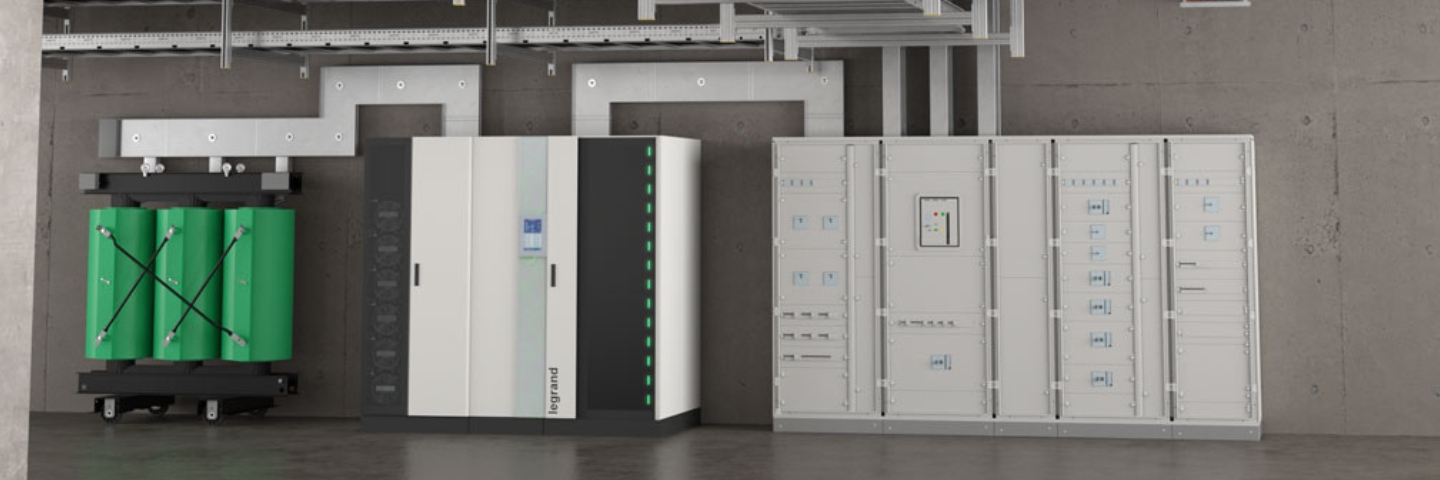
Uninterruptible Power Supply failures remain the leading cause of data center downtime worldwide. As data centers face exponential growth in power requirements, traditional monolithic UPS architectures struggle to deliver the flexibility and resilience modern critical infrastructure demands. Modular UPS systems address this challenge by combining scalability, redundancy, and serviceability in a single architecture.
Understanding Modular UPS Architecture
A modular UPS consists of multiple independent UPS modules operating in parallel within a single system. Unlike conventional UPS designs that require entire units to be paralleled externally, modular architectures integrate smaller power modules internally, typically as hot-swappable components within a common cabinet or frame.
Each power module functions as a complete three-phase UPS unit with its own rectifier, inverter, and control logic. Legrand's Keor MOD, for instance, features 25 kW power modules occupying just 2 rack units, whilst TriMOD offers innovative concept of Three-Phase modularity, consisting of individual single-phase modules ranging from 3.4 kVA to 6.7 kVA. This distributed intelligence architecture ensures that module failures reduce capacity rather than eliminating protection entirely.

The modular approach delivers three core advantages over conventional UPS designs:
Scalability: Power capacity expands incrementally by adding modules as load requirements increase, eliminating the need to oversize initial installations or undertake disruptive replacements. Legrand's Keor MOD scales from 25 kW to 250 kW in a single cabinet, with parallel configurations extending capacity to 600 kW.
Redundancy: Internal N+X redundancy configurations protect against individual module failures without requiring separate UPS units. If one module fails, remaining modules automatically share the load with no interruption to protected equipment.
Serviceability: Hot-swappable modules enable maintenance and component replacement during live operation, eliminating planned downtime for routine service work.
N+X Redundancy Configurations
Redundancy determines how many component failures a UPS system can tolerate whilst maintaining full load protection. In modular systems, N represents the minimum number of modules required to support the connected load, whilst X indicates additional modules providing fault tolerance.
N+1 Redundancy
In an N+1 configuration, the system includes one additional module beyond the minimum required to support the critical load. For example, a 75 kW load using 25 kW modules requires three modules (N = 3). Adding a fourth module creates an N+1 configuration with a total installed capacity of 100 kW. Under normal operation, the load is shared across all four modules at approximately 75% of their rated capacity. If any single module fails, the remaining three modules continue to supply the full 75 kW load without interruption, operating at 100% of their rated output.
This configuration enables maintenance on individual modules without affecting load protection. Technicians can remove a module for service whilst the system continues operating normally, a capability impossible with conventional single-unit systems.
N+2 and Higher Redundancy
For environments requiring very high resilience, N+2 or greater redundancy ensures protection against two simultaneous failures or enables maintenance on two modules without affecting availability. For example, a 100 kW load with 25 kW power modules requires four modules (N = 4). An N+2 configuration uses six modules, providing a total installed capacity of 150 kW. Under normal operation, each module runs at roughly 67% of its rated capacity. If two modules fail or are taken offline for maintenance, the remaining four modules continue supplying the full 100 kW load without interruption.
Higher redundancy levels increase capital expenditure and footprint requirements, but deliver substantially improved availability for mission-critical applications where even brief outages carry severe consequences.
Hot-Swappable Components and Service Continuity
Traditional UPS maintenance requires bypassing the system onto raw mains power, exposing protected loads to utility disturbances during service windows. Modular architectures eliminate this vulnerability through comprehensive hot-swap capabilities.
Legrand's modular UPS platforms implement hot-swap functionality across all critical components:
- Power modules: Remove individual modules for repair or replacement whilst remaining modules continue protecting the load
- Battery drawers: Service battery packs without powering down the UPS system
The Keor MOD features plug-and-play power modules with self-configuring intelligence. When a new module slots into the cabinet, it automatically synchronizes with existing modules and begins sharing load within seconds. No manual configuration or system shutdown is required.
Battery systems adopt similar modularity. Keor MOD uses hot-swappable battery drawers containing five 9 Ah batteries with mechanical anti-extraction stops preventing accidental removal. Keor MOD battery drawers hold up to 24 batteries divided into four blocks of six, enabling quick replacement of individual blocks rather than entire battery strings.
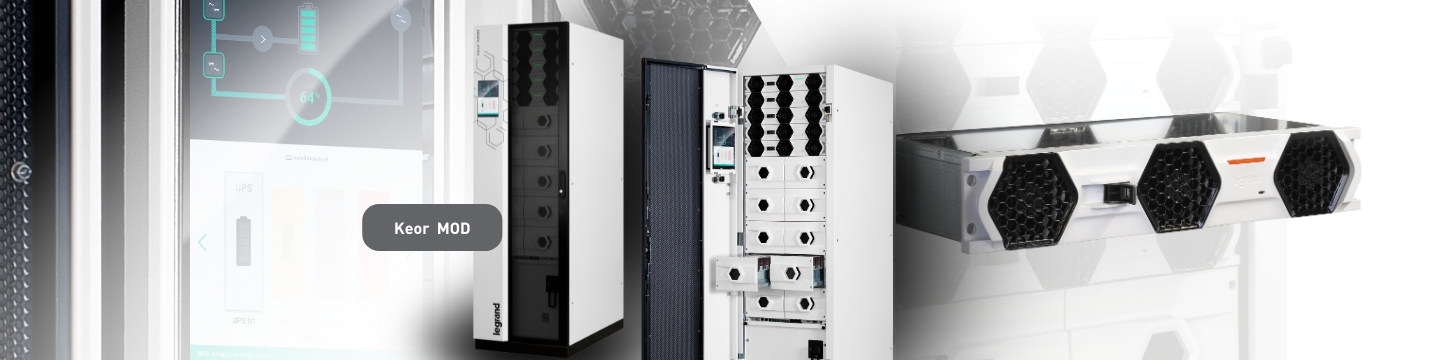
This granular serviceability dramatically improves system availability. Rather than scheduling extended maintenance windows affecting all protected loads, technicians perform targeted interventions on specific components. Annual maintenance that might require four hours of bypass operation with conventional systems completes in minutes with modular platforms, with protected equipment never exposed to unconditioned power.
Scalability for Growing Infrastructure
Data center power requirements rarely remain static. Computing density increases, rack counts expand, and new technologies introduce unanticipated loads. Modular UPS architectures adapt to these evolving demands without forklift upgrades.
Incremental Capacity Expansion
Traditional UPS sizing forces a difficult trade-off: oversize initially to accommodate future growth, wasting capital and operating efficiency, or undersize and face expensive replacement when capacity proves insufficient. Modular systems eliminate this dilemma through pay-as-you-grow scaling.
A data center might begin with 100 kW load but anticipate doubling within three years. Rather than installing a 200 kW conventional UPS running at 50% load, operators deploy a modular system with five 25 kW modules in N+1 configuration, providing 100 kW protected capacity. As load increases, additional modules slot into the existing cabinet, expanding capacity in 25 kW increments aligned with actual requirements.
Legrand's newer-generation modular platforms support both internal module addition and external parallel expansion. Keor MOD cabinets accept up to 24 power modules internally. Beyond single-cabinet capacity, multiple cabinets connect in parallel, extending total system capacity whilst maintaining modular flexibility at both module and cabinet levels.
Efficiency Optimization Through Right-Sizing
UPS efficiency varies significantly with load percentage. Most systems achieve peak efficiency between 40% and 80% load, with performance degrading substantially at very light loads. Oversized conventional UPS systems operating below 30% load waste considerable energy through poor efficiency and unnecessary cooling.
Modular architectures maintain optimal loading throughout the infrastructure lifecycle. Initial installations operate near peak efficiency ranges, and efficiency remains high as modules add to match growing loads. The system perpetually aligns installed capacity with actual requirements.
Keor MOD achieves up to 96.8% efficiency in double conversion mode and 99% in ECO mode. TriMOD similarly delivers high efficiency across its load range. Combined with the ability to scale capacity precisely, these efficiency levels translate to measurable operational expenditure savings over the system lifetime.
Practical Implementation Considerations
Whilst modular UPS architectures deliver clear advantages, successful implementation requires attention to specific technical and operational factors.
Parallel Operation and Module Synchronization
Multiple modules sharing a common output bus must maintain precise voltage and phase synchronization. Modern modular systems employ distributed control algorithms where each module communicates continuously with peers, adjusting output parameters to maintain synchronized operation.
Legrand implements decentralized bypass architecture across its modular range, eliminating single points of failure in bypass circuitry. Each module includes integrated bypass capability, contributing to overall system resilience whilst simplifying power distribution topology.
When connecting multiple cabinets in parallel, proper cabling and equal cable lengths between units ensure balanced load sharing and protect against circulating currents. Installation documentation specifies maximum cable lengths and minimum conductor sizes for parallel interconnections.
Battery Configuration and Autonomy
Battery autonomy in modular systems demands careful planning. Internal battery capacity typically provides 5-10 minutes runtime at full load, sufficient for generator startup in most installations. Extended runtime applications require external battery cabinets.
Battery charging capacity also scales with installed modules. Legrand's modular platforms include integrated battery chargers, with total charging current proportional to the number of installed power modules. This distributed charging architecture reduces recharge times compared to conventional systems with centralized chargers.
Space and Cooling Requirements
Modular systems offer improved power density compared to conventional architectures. Keor MOD delivers 25 kW per 2U module, achieving exceptional power density whilst maintaining serviceable component spacing. Two cabinet configurations support either 125 kW or 250 kW, with parallel expansion enabling higher capacities without proportional footprint increases.
Intelligent fan control adjusts cooling based on actual load and component temperatures rather than operating continuously at maximum speed. This variable cooling approach reduces energy consumption and acoustic emissions compared to fixed-speed fan designs.
Monitoring and Management
Comprehensive monitoring becomes more critical as system complexity increases. Modular UPS platforms provide detailed per-module status information through LCD displays, SNMP interfaces, and dedicated management software.
Legrand's modular systems feature rotating 10-inch touchscreen displays and multicoloured LED status bars providing immediate visual indication of operating conditions. Network management cards enable remote monitoring and integration with building management systems, supporting predictive maintenance programmes through trend analysis and early fault detection.
Modular UPS in Modern Data Center Design
Modern data center architecture increasingly relies on modular infrastructure across power, cooling, and IT systems. Modular UPS platforms align with this distributed, scalable approach whilst addressing the specific resilience requirements of critical electrical infrastructure.
For small to medium installations, products like TriMOD deliver 10-80 kW capacity with N+X redundancy in compact footprints suitable for enterprise data centers and edge computing locations. Mid-range facilities benefit from Keor MOD's 25-250 kW single-cabinet capacity, scalable to 600 kW through parallel configurations.
Large data centers requiring megawatt-scale protection deploy high-power scalable systems like Keor FLEX, featuring hot-scalable 100 kW modules reaching 1.2 MW per unit and paralleling to 4.8 MW. These platforms combine the resilience of modular architecture with the capacity requirements of hyperscale infrastructure.
Edge computing applications present unique UPS requirements: constrained space, variable loads, and distributed locations make traditional maintenance approaches impractical. Modular systems with hot-swap serviceability enable rapid component replacement by less-specialized personnel, reducing mean time to repair and eliminating the need for on-site spare UPS units at every edge location.
Conclusion
Modular UPS architectures represent the convergence of three critical data center requirements: scalability to accommodate growth, redundancy to ensure availability, and serviceability to maintain uptime during maintenance activities. By distributing UPS functionality across hot-swappable modules with N+X redundancy, these systems eliminate the forced trade-offs inherent in conventional designs.
For data center operators navigating increasing power density, tightening efficiency requirements, and escalating uptime expectations, modular UPS platforms deliver measurable advantages in capital efficiency, operational flexibility, and service continuity. As infrastructure demands continue evolving, the ability to scale capacity incrementally whilst maintaining protection during component service ensures modular architectures remain the foundation of resilient data center power protection. Contact us for more informations.
Related Downloads