





















 Canada
 Latin America (English)
 Latin America (Espanol)
 USA
USA
 China
China
 India
India
 Japan
Japan
 Republic of Korea
 South East Asia (English)
 Austria
 Belgium
 France
 Germany
 Italy
Italy
 Netherlands
 Others
 Spain
Spain
 Switzerland
 Turkey
 UK
UK
 Africa (english)
 Africa (français)
 Middle East (english)
 Australia
 New Zealand


Design Philosophies Behind Modular Power Systems for Data Center UPS
The design philosophy behind Legrand's modular power systems centers on creating flexible, scalable UPS architectures that adapt to evolving data center requirements. This approach prioritizes modularity, energy efficiency, and seamless integration to support business continuity while addressing the dynamic power demands of modern IT infrastructure.
Modular Architecture as a Core Design Principle
Modular design forms the foundation of Legrand's data center UPS philosophy. Rather than deploying monolithic systems that require complete replacement to scale capacity, modular platforms consist of multiple independent power modules that can be added or removed without system downtime. This architecture enables facilities to right-size initial deployments and expand incrementally as computing loads grow.
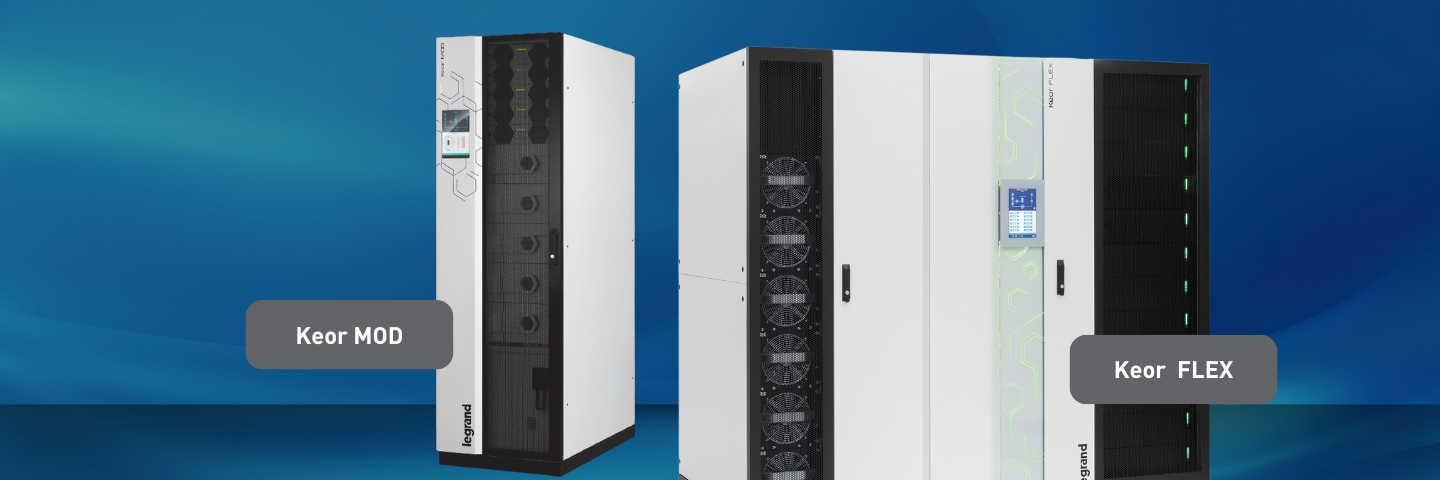
The Keor MOD exemplifies this philosophy with power modules ranging from 25kW to 250kW within single cabinets. Each module operates as a complete three-phase UPS system in just two rack units, featuring integrated rectifier, inverter, battery charger, and bypass circuits. Facilities can begin with minimal capacity and add modules as demand increases, avoiding the capital expenditure of oversized infrastructure while maintaining expansion flexibility.
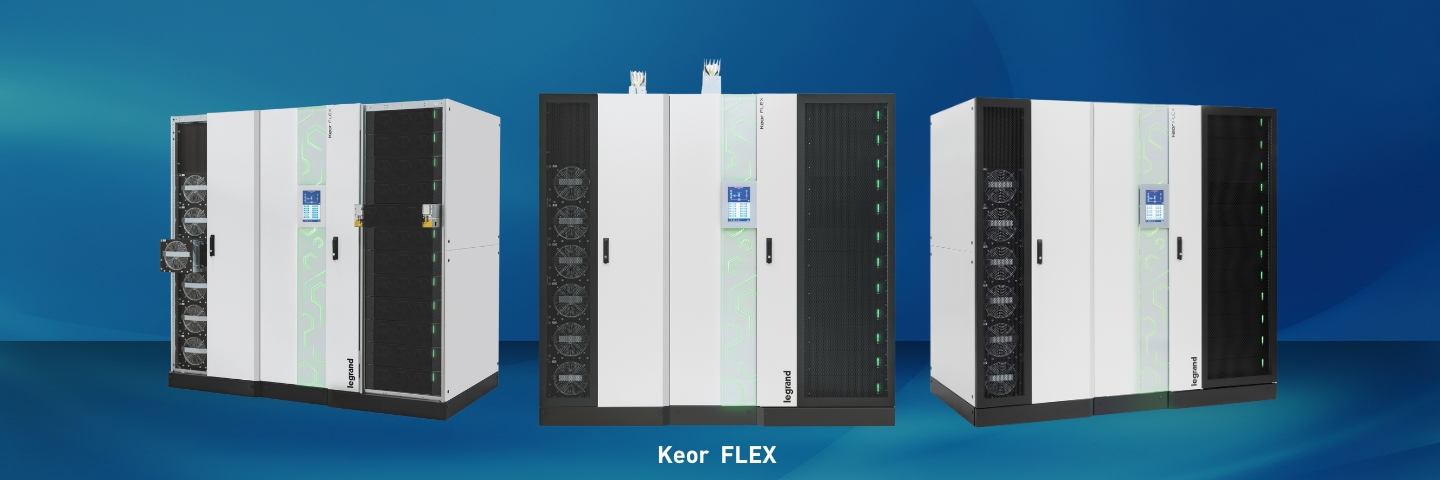
Keor FLEX extends modular principles to hyperscale deployments through hot-swappable 100kW modules. Systems scale from individual modules up to 1.2 MW per frame, with parallel configurations supporting 4.8 MW. This scalability addresses both directions, allowing facilities to scale up for growth or scale down temporarily during equipment transitions or maintenance periods.
Hot-Swap Capability for Continuous Operation
Hot-swap functionality represents a critical design element enabling maintenance and upgrades without service interruption. Legrand engineers modular platforms where every essential component, including power modules and battery packs, can be removed and replaced while the system continues supplying protected loads.
The mechanical and electrical design of hot-swappable modules includes safety interlocks preventing accidental removal during operation. Simple front-mounted switches provide both mechanical connection and electrical isolation, requiring deliberate action to extract modules. This design protects technicians while ensuring system stability during service procedures.
Battery drawers in systems like Keor MOD feature plug-in connections with anti-extraction stops, allowing battery replacement without powering down connected equipment. This capability proves essential for data centers requiring continuous uptime where even brief maintenance windows create operational challenges.

Power Conversion Standards and Output Quality
Reliable power conversion standards ensure Legrand UPS systems deliver consistent AC outputs meeting strict quality requirements. Online double-conversion topology continuously processes all power through rectifier and inverter stages, producing clean sine wave AC output independent of input power conditions.
The rectifier stage converts incoming AC to regulated DC, implementing power factor correction to achieve input power factor greater than 0.99. This high power factor reduces current draw from upstream electrical infrastructure and minimizes installation costs. Rectifier reduces input current harmonic distortion below 3% , ensuring compatibility with generators and sensitive electrical systems.
Inverter stages employ high-frequency switching to generate pure sine wave outputs with voltage regulation within plus or minus 1% under static conditions. Output frequency maintains precise 50 Hz or 60 Hz operation with tight tolerance. Total harmonic distortion remains below 2% for linear loads and below 4% for non-linear loads, protecting connected IT equipment from power quality issues.
Energy Efficiency Through Advanced Technology
Energy efficiency drives significant design decisions across Legrand's UPS portfolio. Higher efficiency reduces operating costs through lower electricity consumption and decreased cooling requirements, directly impacting facility Power Usage Effectiveness metrics.
Silicon Carbide semiconductor technology in Keor FLEX achieves 98.6% efficiency in double conversion mode, representing industry-leading performance. SiC devices enable higher switching frequencies with reduced losses compared to traditional silicon semiconductors, minimizing heat generation within inverter circuits. This efficiency advantage reduces both direct energy waste and indirect cooling costs.
ECO mode operation available across multiple platforms reaches 99% efficiency by connecting loads directly to conditioned input power while maintaining inverter readiness. This operating mode suits environments with stable utility power where maximum efficiency takes priority over absolute isolation, though facilities must accept slightly reduced protection during ECO mode operation.
Unity output power factor ensures connected equipment utilizes full UPS capacity. Keor MOD and Keor FLEX deliver unity power factor where kVA equals kW, eliminating the capacity derating associated with traditional 0.8 or 0.9 power factor designs.
Scalability for Evolving IT Infrastructure
Data center infrastructure must accommodate unpredictable growth and changing technology requirements. Modular UPS architecture provides the scalability essential for long-term facility planning without excessive initial capital expenditure.
Incremental capacity additions match actual demand growth rather than requiring oversized deployments based on projected peak loads that may never materialize. Facilities install only the modules needed for current equipment, adding capacity as server populations increase or computing density rises. This approach optimizes capital allocation while maintaining protection for future expansion.
Parallel operation extends scalability beyond single-frame limits. Keor MOD systems support parallel connection of multiple units up to 600kW total capacity. Keor FLEX platforms based on 100kW power modules reach 1.2 MW in single units, with parallel configurations scaling to 4.8 MW for the largest hyperscale deployments.
Redundancy Configurations for High Availability
Modular architecture inherently supports flexible redundancy schemes essential for mission-critical operations. Rather than deploying separate UPS systems for N+1 redundancy, modular platforms achieve redundancy through additional modules within single frames.
N+X configurations provide backup capacity where X represents spare modules beyond the N modules required for current load. A facility requiring 100kW might deploy five 25kW modules, providing 25kW of redundant capacity while operating at optimal efficiency. Module failures reduce available capacity without complete system outage, and failed modules can be replaced during normal operation.
This internal redundancy approach offers advantages over traditional parallel UPS configurations. Single cabinets house all modules, reducing installation space and simplifying electrical connections. Common bus and control systems eliminate synchronization concerns between separate UPS units. Maintenance becomes straightforward with hot-swappable modules rather than complex parallel system procedures.
Integration Within the UPS Ecosystem
Legrand modular UPS platforms as integrated components within comprehensive data center power ecosystems rather than standalone products. Systems interface with upstream generators and downstream power distribution units through standardized electrical connections supporting various installation configurations.
Extended communication interfaces provide seamless monitoring and control integration. From standard RS232, RS485, USB, to SNMP interfaces connect UPS systems to building management platforms and data center infrastructure management software. Network cards enable remote monitoring, alarm notification, and controlled shutdown sequences coordinating with server infrastructure.
Supporting Business Continuity Requirements
Design decisions throughout Legrand's modular UPS platforms prioritize business continuity objectives. Every architectural choice, from hot-swap capability to redundancy configurations, addresses the fundamental requirement that protected systems never experience power interruption.
Mean Time To Repair (MTTR) receives careful attention through modular serviceability. Hot-swappable components allow rapid module replacement, typically under five minutes for trained technicians. Front-accessible designs eliminate the need to access rear cabinet areas in dense equipment rows. Predictive diagnostics identify developing issues before failures occur, enabling proactive maintenance during scheduled windows.
Battery management systems extend backup duration through intelligent discharge control and charge optimization. Temperature-compensated charging adjusts parameters based on ambient conditions, maximizing battery capacity while preventing thermal stress that degrades service life. Battery monitoring tracks individual block voltage and temperature, providing early warning of degraded cells requiring replacement.
Addressing Data Center Planner Requirements
Facility planners require power solutions balancing immediate needs against uncertain future demands. Legrand's modular philosophy addresses this challenge through right-sizing capabilities that eliminate the traditional dilemma between undersized systems lacking growth capacity and oversized installations wasting capital and efficiency.
Initial deployments can match actual current loads with confidence that expansion remains straightforward. A facility might deploy a Keor MOD frame with three 25kW modules supporting 75kW of initial IT load, representing modest capital outlay. As equipment populations increase, additional modules integrate without electrical work or system reconfiguration, growing capacity to 250kW within the same footprint.
Standardized modules across platform families simplify procurement and spare parts inventory. The same 25kW module architecture serves multiple deployment sizes, allowing facilities to maintain common spare modules supporting various installations. This standardization extends to battery cabinets, communication interfaces, and monitoring systems.
Sustainable Design Principles
Sustainability considerations influence design decisions throughout the development process. High-efficiency operation reduces electricity consumption and associated carbon emissions. Legrand's Keor FLEX efficiency of 98.6% in double conversion mode minimizes energy waste while reducing facility cooling loads.
Modular architecture supports sustainability through extended system lifecycles. Rather than replacing entire UPS systems when capacity requirements change, facilities add or remove modules while retaining core infrastructure. This approach reduces electronic waste while optimizing resource utilization across decades of service.
Manufacturing processes, component selection, and end-of-life considerations follow Legrand's commitment to reducing environmental impact throughout product lifecycles. EN 62040-4 certifications and Product Environmental Profiles document sustainability metrics, enabling facility planners to evaluate environmental performance alongside technical specifications.
Partner with Legrand for Scalable UPS Solutions
Legrand's modular UPS platforms embody design philosophies prioritizing flexibility, efficiency, and reliability for data center applications. From Keor MOD systems serving mid-sized facilities to Keor FLEX deployments supporting hyperscale operations, our solutions provide the scalability and integration essential for evolving IT infrastructure. Contact Legrand to discuss how modular power architecture can optimize your facility's power protection strategy.
Related Downloads