





















 Canada
 Latin America (English)
 Latin America (Espanol)
 USA
USA
 China
China
 India
India
 Japan
Japan
 Republic of Korea
 South East Asia (English)
 Austria
 Belgium
 France
 Germany
 Italy
Italy
 Netherlands
 Others
 Spain
Spain
 Switzerland
 Turkey
 UK
UK
 Africa (english)
 Africa (français)
 Middle East (english)
 Australia
 New Zealand


Comparing Line-Interactive and Double-Conversion UPS Topologies for IT, Edge, and Critical Power Applications
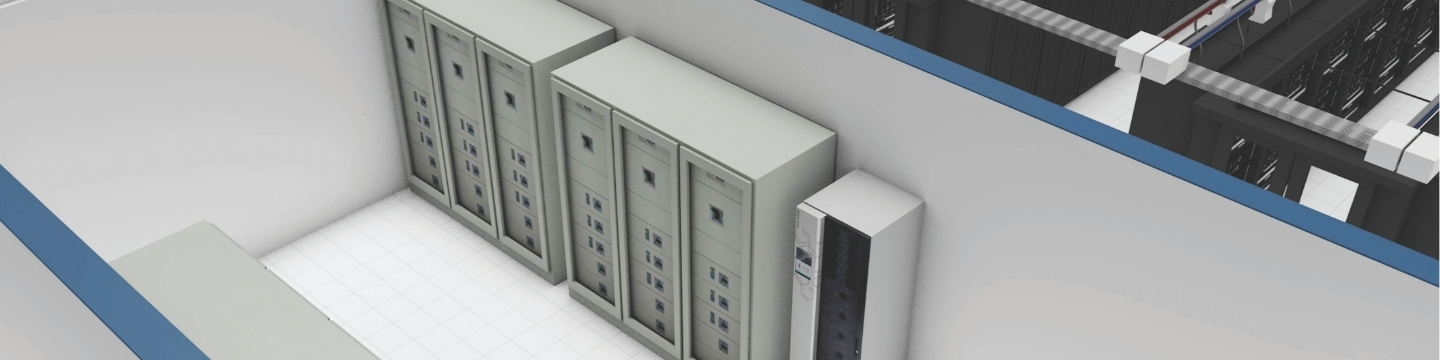
Understanding the difference between line-interactive and online double-conversion UPS topologies helps organizations select the right power protection system for their specific requirements. Legrand offers both architectures within its product range, each designed to address distinct power quality challenges and application demands across data center and critical infrastructure environments.
Fundamental Topology Differences
The core difference between these UPS topologies lies in how they process power and when the inverter or battery system engages. Line-interactive UPS maintains a direct connection between the main AC grid and connected devices during normal operation, while online double-conversion UPS continuously converts all power through its rectifier and inverter circuits.
Line-interactive systems like Legrand's Keor SP (600VA to 2000VA) and Keor SPE (750VA to 3000VA in both tower and rack-mount configurations) use an automatic voltage regulator (AVR) with buck/boost transformers to correct minor voltage fluctuations without switching to battery backup. The battery and inverter remain on standby, activating only when input power fails or falls outside acceptable voltage ranges. This design extends battery life by minimizing unnecessary discharge cycles.
Online double-conversion topology, employed across Legrand's data center UPS families, continuously processes all incoming AC power. The rectifier converts grid AC to DC, which simultaneously charges batteries and supplies the inverter. The inverter then converts this DC back to regulated AC output. This continuous double-conversion operation provides complete isolation between input power and connected equipment at all times.
Component Architecture and Power Flow
Line-interactive UPS architecture incorporates relatively simple component configurations. The main circuit path connects input AC directly to output through the AVR device, which compensates for voltage variations using tap-changing transformers. The battery charger operates independently, maintaining battery charge status. When utility power fails, a transfer switch disconnects the load from the input and connects it to the inverter output, which draws energy from the battery bank.
Double-conversion systems feature more complex circuit topologies with dedicated rectifier and inverter stages operating continuously. Legrand's Keor HPE three-phase systems (60kVA to 600kVA) utilize 3-Level IGBT technology with Digital Signal Processor (DSP) microprocessors managing power factor correction, achieving input power factor typically greater than 0.99 under normal operating conditions. The Keor DK UPS systems (1kVA to 20kVA) employ high-frequency PWM technology with transformer-free design.
The battery integration differs substantially between topologies. Line-interactive systems charge batteries through a dedicated charging circuit and activate the inverter only during power disruptions. Online systems integrate battery management into the continuous conversion process, where batteries connect to the DC bus that links the rectifier and inverter circuits.
Voltage Regulation and Power Quality
Line-interactive UPS provides voltage regulation through AVR technology that corrects minor power fluctuations. Legrand's Keor SPE delivers pure sine wave output when operating on battery, protecting sensitive equipment from power quality issues. However, during normal operation with acceptable input voltage, the output voltage and frequency track the input supply with AVR compensation applied.
Online double-conversion offers superior voltage regulation by generating a new, clean AC supply from the inverter at all times. The output maintains precise voltage and frequency regardless of input power quality. Legrand's VFI (Voltage and Frequency Independent) classification double-conversion systems produce sinusoidal output waveforms with total harmonic distortion typically below 3%.
The continuous inverter operation in double-conversion topology eliminates voltage sags, swells, frequency variations, and harmonic distortion present in utility power. Connected equipment receives perfectly regulated electricity, even when the main grid experiences significant disturbances.
Transfer Time Considerations
Transfer time represents a critical specification differentiating these topologies. Line-interactive UPS must switch from normal mode to battery operation when input power fails, introducing a brief transition period. While this transfer occurs rapidly, typically within milliseconds, it does represent a momentary discontinuity in power delivery. Most modern IT equipment with switch-mode power supplies tolerate this brief interruption without issue.
Online double-conversion systems deliver zero transfer time. Since the inverter continuously supplies the output, no switching occurs when grid power fails. The system simply continues drawing energy from the batteries instead of the rectifier, with no interruption to connected equipment. This zero-transfer-time operation provides maximum protection for the most sensitive equipment.
Energy Efficiency and Operating Costs
Line-interactive topology generally offers higher efficiency during normal operation since power flows directly from input to output with minimal conversion losses. The AVR components introduce some losses, but overall efficiency remains high when operating from utility power. This reduced energy consumption translates to lower electricity costs and less heat generation requiring cooling capacity.
Online double-conversion systems historically showed lower efficiency due to continuous power conversion losses. However, modern Legrand designs have significantly improved performance. The Keor HPE achieves up to 96.4% efficiency in online mode, whilst the Keor FLEX modular system reaches industry-leading 98.6% efficiency in double conversion mode through Silicon Carbide (SiC) technology. Many double-conversion systems also offer ECO mode operation for improved efficiency during stable utility conditions.
Battery replacement requirements affect operating costs across both topologies. Batteries typically require replacement every three to five years depending on operating temperature, discharge depth, and maintenance regime.. Line-interactive systems may extend battery life through reduced cycling, while double-conversion systems maintain continuous float charge operation. Note that modern UPS systems support various battery technologies including VRLA, lithium-ion, and other chemistries depending on specific model capabilities.
Application Suitability
Line-interactive UPS proves suitable for applications where brief transfer times are acceptable and power quality issues remain moderate. The Keor SP series (600VA to 2000VA) and Keor SPE models (750VA to 3000VA) protect workstations, small servers, and network equipment in office and edge computing environments.
Typical line-interactive applications:
- Office workstations and desktop computers
- Network switches and routers in closets
- Point-of-sale systems and retail equipment
- Small server installations outside core data center environments
Online double-conversion topology serves critical business loads requiring maximum reliability and zero-tolerance for power interruptions. Legrand's Keor HPE three-phase systems (60kVA to 600kVA) and Keor DK models (1kVA to 20kVA) address applications where even momentary power discontinuities could cause data loss or equipment malfunction.
Critical double-conversion applications:
- Mission-critical servers and storage systems
- Data center core infrastructure
- Industrial automation and control systems
- Medical equipment requiring continuous power
- Financial transaction processing systems
For larger data center deployments, Legrand's modular UPS families provide scalable double-conversion protection. The Keor FLEX (up to 1.2MW per frame, expandable to 4.8MW) offers hot-swappable modularity for hyperscale and AI workloads. The Keor MOD (25kW to 250kW, scalable to 600kW) addresses mid-range facilities, whilst TriMOD (10kW to 80kW) serves enterprise data centers with compact modular architecture.
Maintenance and Reliability Factors
Line-interactive systems feature fewer active components operating during normal conditions, potentially reducing component stress and maintenance requirements. The AVR transformers and transfer switches represent the primary wear items beyond batteries. Legrand's Keor SPE incorporates hot-swappable batteries, allowing battery replacement without powering down connected equipment.
Double-conversion UPS requires continuous operation of rectifier and inverter circuits, placing ongoing demand on power semiconductor devices and cooling systems. However, modern IGBT technology demonstrates excellent reliability under continuous duty. The absence of mechanical transfer switches eliminates one potential failure point, while continuous monitoring capabilities through DSP control provide early warning of developing issues.
Both topologies benefit from Legrand's integrated diagnostics and communication capabilities. RS232, USB, and SNMP interfaces enable remote monitoring of system status, battery condition, and load levels. This visibility supports proactive maintenance scheduling and rapid response to any anomalies detected during operation.
Selecting the Right Topology
The choice between line-interactive and online double-conversion depends on specific application requirements. Organizations prioritizing maximum uptime and zero power disruption for servers, storage systems, and sensitive industrial controls require online double-conversion topology.
Choose line-interactive when:
- Brief transfer times are acceptable for connected equipment
- Operating in stable power environments with minor fluctuations
- Energy efficiency and lower operating costs are priorities
- Protecting office equipment and standard workstations
- Budget constraints require cost-effective solutions
Choose double-conversion when:
- Zero transfer time is essential for critical operations
- Complete isolation from grid anomalies is required
- Applications demand continuous voltage regulation
- Protecting medical, industrial, or mission-critical systems
- Power quality in the facility is poor or unreliable
Budget considerations factor into topology selection. Line-interactive systems typically offer lower initial costs and reduced operating expenses through higher efficiency. Double-conversion systems command premium pricing but deliver superior protection and voltage regulation justifying the investment for critical applications.
Legrand's Comprehensive UPS Portfolio
Legrand's UPS range addresses diverse protection requirements across both topologies:
Line-Interactive Systems:
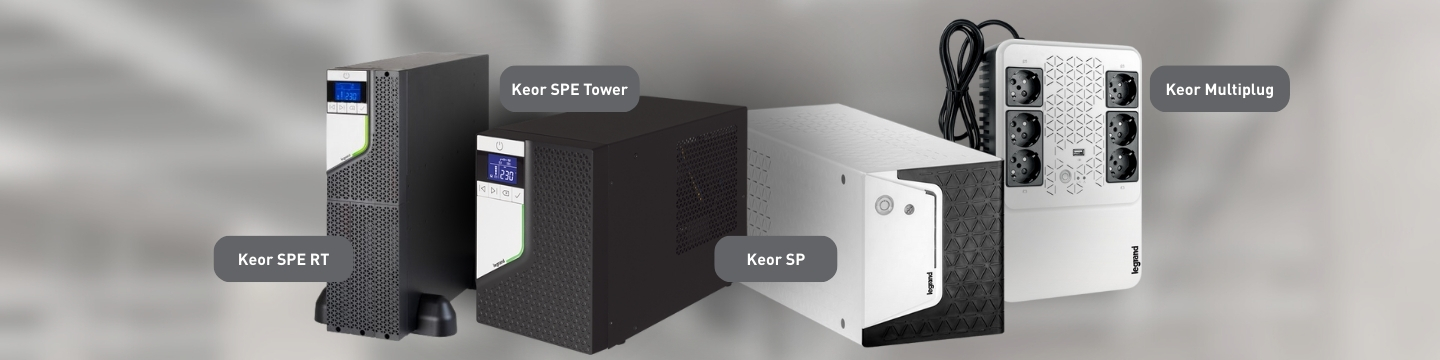
- Keor SP: 600VA to 2000VA for basic workstation protection
- Keor SPE Tower: 750VA to 3000VA with pure sine wave output
- Keor SPE RT: 750VA to 3000VA convertible tower/rack-mount design
- Keor Multiplug: Compact 600VA to 800VA with integrated stabilizer
Online Double-Conversion Conventional Systems:
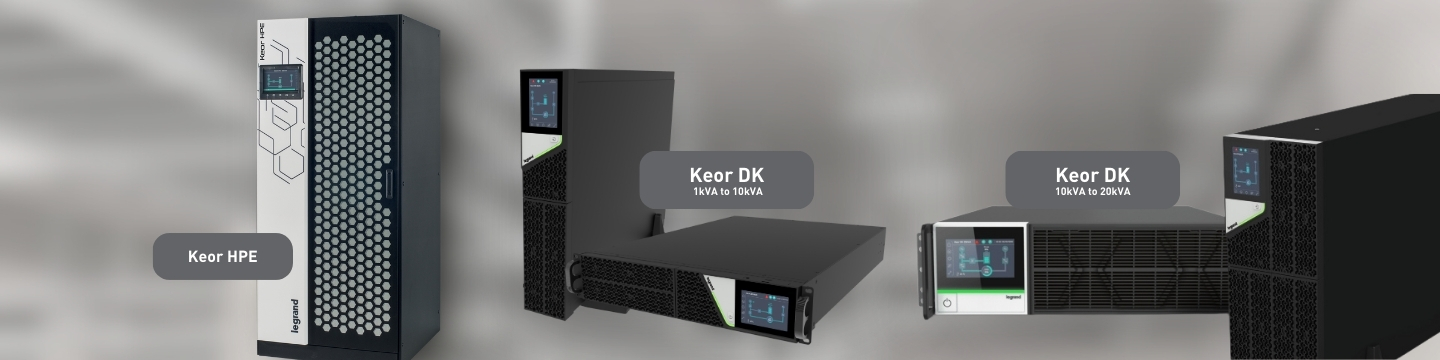
- Keor DK: 1kVA to 10kVA single-phase with reversible display
- Keor DK: 10kVA to 20kVA 3-1, 3-1, 1-1 phase configuration in rack form
- Keor HPE: 60kVA to 600kVA three-phase with 3-Level IGBT technology
Online Double-Conversion Modular Systems:
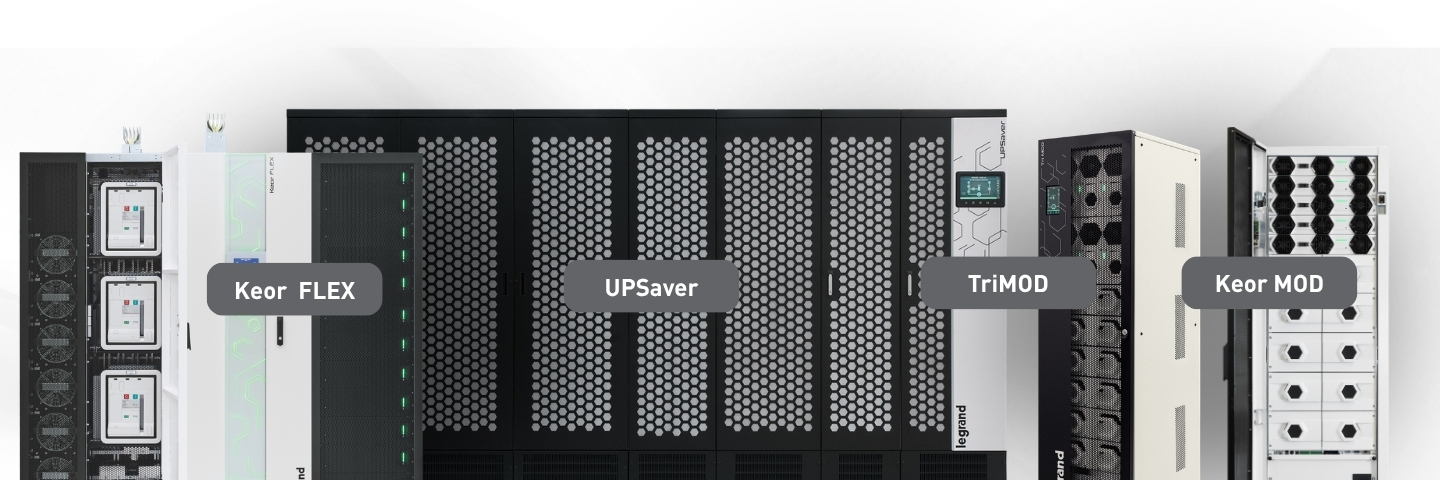
- Keor FLEX: Up to 1.2MW per frame (4.8MW parallel), 98.5% efficiency with SiC technology
- Keor MOD: 25kW to 250kW (600kW parallel) with hot-swappable 25kW modules
- Keor MOD RI: 25kVA and 50kVA configurations
- TriMOD: 10kW to 80kW with individual single-phase modules
Contact Legrand's power protection specialists to determine the optimal UPS topology and capacity for your specific installation needs.
Related Downloads