























 Canada
 Latin America (English)
 Latin America (Espanol)
 USA
USA
 China
China
 India
India
 Japan
Japan
 Republic of Korea
 South East Asia (English)
 Austria
 Belgium
 France
 Germany
 Italy
Italy
 Netherlands
 Others
 Spain
Spain
 Switzerland
 Turkey
 UK
UK
 Africa (english)
 Africa (français)
 Middle East (english)
 Australia
 New Zealand


Pure Sine Wave Inverter Technology for Clean and Stable Power Delivery

Pure sine wave inverter technology forms a fundamental component of reliable UPS systems that protect sensitive IT equipment in data centers. Legrand integrates high-efficiency electrical inverters into its UPS platforms, converting DC battery power into clean AC electricity that precisely replicates utility grid characteristics, ensuring optimal performance for mission-critical applications.
Understanding Pure Sine Wave Output
A pure sine wave represents the ideal form of AC electrical power, characterized by smooth, continuous oscillations between positive and negative voltage peaks. This waveform matches the electricity supplied by utility providers and the power form that sensitive electronic equipment expects to receive. The sine wave pattern ensures consistent voltage transitions without abrupt changes that could stress delicate circuits or cause equipment malfunction.
Legrand UPS systems generating pure sine wave output utilize advanced PWM (Pulse Width Modulation) high-frequency technology. Systems like the Keor SPE line-interactive models and Keor DK online double-conversion units produce this clean waveform through sophisticated inverter circuits. The inverter generates rapid switching pulses that, when filtered, create a smooth, regulated sinusoidal output independent of grid disturbances, protecting computers, servers, networking equipment, and other sensitive devices from power quality issues.
DC to AC Power Conversion Process
The inverter device within a UPS system performs the essential function of converting stored DC battery energy into usable AC electricity. When utility power fails or experiences disturbances, batteries provide DC voltage to the inverter circuit. The inverter then transforms this DC into regulated AC output through sophisticated power electronics.
Legrand's online double-conversion UPS platforms continuously perform this conversion process. In systems such as the Keor HPE (60kVA to 600kVA), the rectifier converts incoming grid AC to DC, which charges the batteries and supplies the inverter stage. The inverter then converts the DC back to AC, producing a stable sine wave output with precise voltage and frequency control. This continuous conversion ensures complete isolation between input power anomalies and connected equipment.
Line-interactive models like the Keor SPE (750VA to 3000VA) employ a different application of inverter technology. During normal operation, equipment receives conditioned power from the grid through an automatic voltage regulator. When input power fails, the system switches to inverter operation, where the inverter converts battery DC into pure sine wave AC to maintain power delivery without interruption.
PWM Technology for High-Efficiency Energy Conversion
PWM high-frequency technology enables modern inverters to achieve excellent efficiency while generating clean sine wave outputs. The inverter rapidly switches power transistors on and off at frequencies measured in kilohertz, creating pulses of varying width. By modulating these pulse widths according to a sinusoidal pattern, the inverter generates an output that, after filtering, closely approximates a perfect sine wave.
Legrand UPS systems using this technology deliver high energy conversion efficiency. Actual performance, however, is determined by the specific product family, operating mode, and load profile, and must be evaluated on a model-by-model basis.
Keor FLEX specific performance:
- 98.6% efficiency in double conversion mode with Silicon Carbide technology
- 99% efficiency in ECO mode operation
Keor MOD and Keor MOD RI specific performance:
- Up to 96.8% efficiency in standard double conversion operation
- Up to 99% efficiency in ECO mode
Keor HPE specific performance:
- Up to 96.4% efficiency in online mode
These high-efficiency levels minimize electricity losses during the DC to AC conversion process, reducing operating costs and heat generation that would otherwise require additional cooling capacity.
Frequency and Current Control for Grid Compatibility
Precise frequency control ensures inverter output maintains stable AC cycles that match grid standards. Legrand UPS inverters regulate output frequency to 50 Hz or 60 Hz depending on regional requirements, with tight tolerance that prevents frequency drift. This stable frequency proves essential for equipment containing motors, transformers, and timing circuits that depend on consistent AC cycles for proper operation.
Current control mechanisms within the inverter circuit manage load demands dynamically. As connected equipment draws varying amounts of current, the inverter adjusts its output to maintain stable voltage while supplying the required current. Three-level IGBT (Insulated Gate Bipolar Transistor) inverter technology in the Keor HPE provides enhanced current control with reduced harmonic distortion, ensuring clean power delivery across a wide load range..
Battery Charge Management Integration
Effective battery charge management directly impacts UPS reliability and battery lifespan. Legrand UPS systems integrate intelligent charging circuits that work in coordination with the inverter to optimize battery health. The charging system monitors battery voltage, current, and temperature to apply appropriate charge rates that fully replenish capacity without overcharging damage.
Modern UPS systems support various battery chemistries including VRLA (Valve Regulated Lead Acid), lithium-ion, and other technologies depending on specific model capabilities. Each chemistry requires tailored charge management approaches. The integrated charger applies multi-stage charging algorithms that transition between bulk charge, absorption, and float stages based on battery conditions and chemistry requirements. This intelligent approach reduces charge time while preventing the thermal stress that degrades battery capacity over repeated cycles.
Reduced Electricity Losses and Sustainability Benefits
High inverter efficiency translates directly to reduced electricity consumption and lower operating costs. Every percentage point of efficiency improvement reduces wasted energy that would otherwise generate heat requiring cooling infrastructure. The 98.6% efficiency achieved by Keor FLEX through Silicon Carbide technology represents very high efficiency levels for double-conversion UPS systems..
Beyond immediate cost savings, efficient inverter technology supports sustainability objectives by reducing overall facility energy demand. Data centers consuming megawatts of power realize significant environmental benefits from high-efficiency UPS systems. The reduced electrical losses decrease both direct energy consumption and indirect cooling requirements, contributing to improved Power Usage Effectiveness (PUE) metrics that measure data center efficiency.
Protection for Sensitive IT Equipment
Pure sine wave output provides essential protection for the complex power supplies used in modern IT equipment. Server power supplies, networking devices, and storage systems incorporate sophisticated AC-to-DC conversion circuits designed to operate with clean sine wave input. Modified sine wave or square wave power can cause these supplies to operate inefficiently, generate excess heat, or experience premature component failure.
Benefits of pure sine wave for IT equipment:
- Eliminates voltage spikes and harmonic distortion that damage sensitive electronics
- Ensures proper operation of equipment with motors and transformers
- Prevents excessive heating in power supply circuits
- Extends equipment lifespan through consistent, clean power delivery
- Supports optimal performance of processors and memory systems
Legrand's commitment to pure sine wave technology across its UPS range ensures broad compatibility with modern IT and infrastructure equipment. From line-interactive Keor SPE models protecting office workstations to the large-scale Keor FLEX systems supporting data center infrastructure, pure sine wave output guarantees that connected devices receive the quality power they require for reliable operation and maximum lifespan.
Application Across Data Center Infrastructure
Different data center applications require varying approaches to inverter implementation. Edge computing locations with space constraints benefit from compact line-interactive UPS systems where the inverter operates only during power disruptions. These installations prioritize efficiency during normal operation while providing pure sine wave backup power when needed.
Core data center facilities housing mission-critical servers and storage require continuous inverter operation through online double-conversion topology. Modular systems deliver this protection at scale:

Keor FLEX modular capacity:
- 100kW power modules
- Up to 1.2MW in single frame configuration
- Expandable to 4.8MW through parallel operation
Keor MOD modular capacity:
- 25kW power modules
- Up to 250kW in single cabinet
- Scalable to 600kW through parallel configurations
Each power module contains its own complete inverter circuit, providing both scalability and redundancy through distributed architecture.
Future-Ready Inverter Technology
Legrand's ongoing development of inverter technology focuses on further efficiency improvements and enhanced functionality. Silicon Carbide semiconductors in the Keor FLEX demonstrate the transition to advanced materials that enable higher switching frequencies and lower losses. These innovations allow inverter circuits to operate more efficiently while generating less heat, supporting the industry trend toward higher-density data center deployments.
The integration of digital control systems enhances inverter performance monitoring and optimization. Microprocessor and DSP-based control in Legrand UPS platforms enables sophisticated algorithms that continuously optimize inverter operation based on load conditions, temperature, and other operating parameters. This intelligent control maximizes efficiency while ensuring stable sine wave output across varying operating conditions.
Legrand's Comprehensive UPS Solutions
Legrand's UPS portfolio spans diverse applications and capacity requirements:
Line-Interactive with Pure Sine Wave:

- Keor SPE Tower: 750VA to 3000VA
- Keor SPE RT: 750VA to 3000VA (convertible)
- Keor SP: 600VA to 2000VA
Online Double-Conversion Conventional:
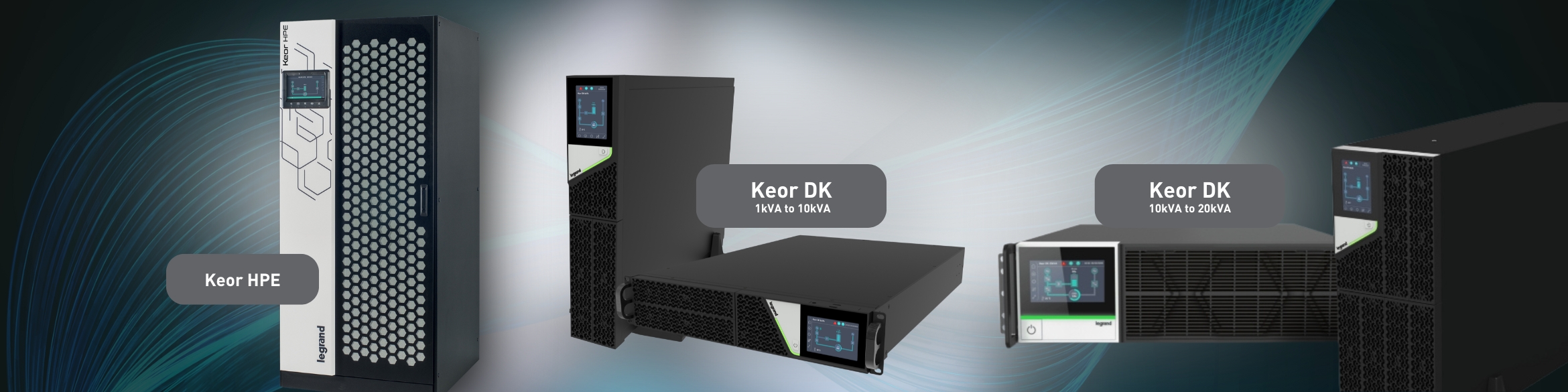
- Keor DK: 1kVA to 20kVA
- Keor HPE: 60kVA to 600kVA
Online Double-Conversion Modular:
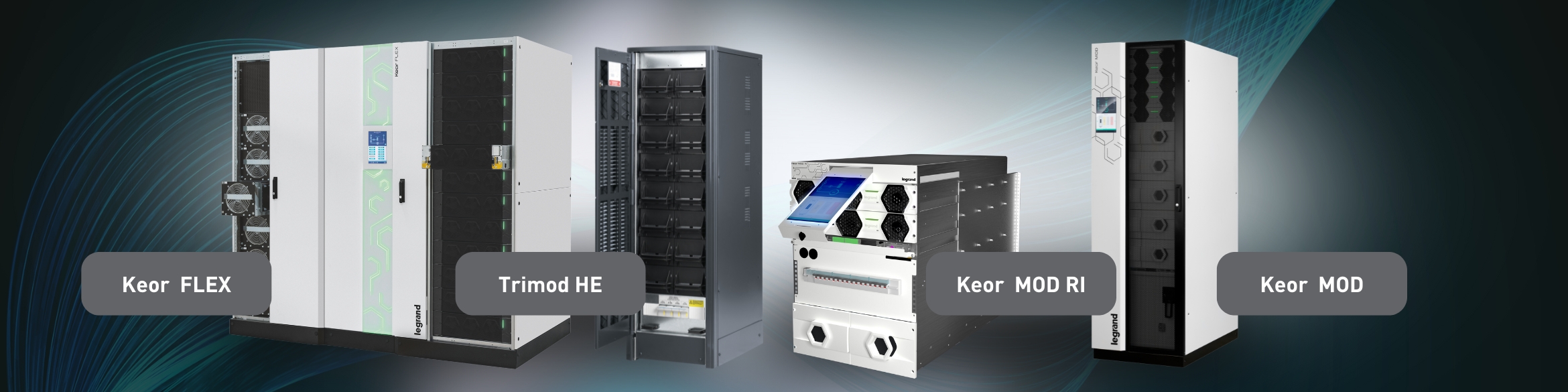
- Keor FLEX: Up to 1.2MW (4.8MW parallel) with SiC inverters
- Keor MOD: 25kW to 250kW (600kW parallel)
- TRIMOD HE: 10kW to 80kW
- Keor MOD RI: 25kVA and 50kVA configurations
Contact Legrand to discuss how our inverter-based UPS platforms can optimize power quality and efficiency for your facility.
Related Downloads